
A cracked, porous, or grout-lined kitchen floor isn’t just an eyesore — it’s a compliance risk, a WHS liability, and a threat to your food safety rating.
If you operate a restaurant, café, aged care facility, food processing plant, or any commercial kitchen across Wide Bay — Hervey Bay, Bundaberg, Maryborough, Gympie, or the surrounding Burnett region — the floor beneath your feet has to work as hard as everyone on your team.
At Supreme Coatings AU, we’ve installed commercial kitchen epoxy flooring across Wide Bay for businesses that can’t afford shortcuts. This guide explains why seamless epoxy is the benchmark choice for food-service floors in Queensland, what you need to know about compliance, and exactly what our installation process looks like.
Free on-site assessments available across Wide Bay. Call (07) 4124 6084 or request a quote online.
The Problem with Standard Kitchen Floors
Most commercial kitchens across Wide Bay are built on either bare concrete, ceramic tile, or vinyl sheet — all of which share a critical flaw in a food service environment: they trap contamination.
- Bare concrete is highly porous. Grease, animal fat, cleaning chemicals, and moisture soak into the slab, breed bacteria, and degrade the concrete over time.
- Ceramic tile looks clean but the grout lines are almost impossible to sanitise properly. They collect fat, food particles, and moisture — exactly the conditions bacteria need.
- Vinyl sheet deteriorates under repeated high-pressure hosing, hot water, and commercial degreasers. Seams lift, water gets underneath, and mould follows.
What every commercial kitchen floor actually needs is a surface that is smooth and impervious to liquids, free from cracks and crevices, resistant to pests and ponding water, and genuinely easy to clean and sanitise day after day.
Bare concrete, grout-lined tiles, and deteriorating vinyl can’t deliver that. A seamless, non-porous epoxy floor can — and does.
What Is Commercial Kitchen Epoxy Flooring?
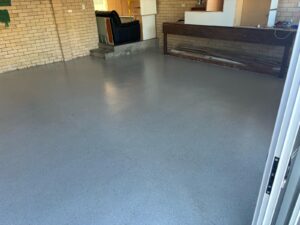
Commercial kitchen epoxy flooring is a multi-layer resin coating system applied directly to a prepared concrete substrate. The result is a single, seamless, non-porous surface with no joints, cracks, or grout lines where bacteria can hide.
A correctly specified commercial kitchen system typically includes:
- Diamond-ground concrete preparation — opens the slab’s pore structure for a permanent mechanical bond
- Epoxy primer — penetrating layer that seals the concrete and prevents moisture outgassing
- Build coat(s) — the main epoxy body, applied to specification thickness (typically 2–5mm for heavy commercial use)
- Anti-slip aggregate broadcast — quartz or aluminium oxide granules rated to AS 4586 slip resistance standards
- Anti-microbial topcoat — a chemical-resistant, food-grade finish that inhibits bacteria and mould growth
The final surface is seamless from wall to wall, with optional coved skirting sealing the floor-to-wall junction — eliminating the last place moisture and pests can enter.
Commercial Kitchen Epoxy Flooring Wide Bay — Why Local Conditions Matter
Wide Bay’s climate creates flooring challenges that installers from Brisbane or the Gold Coast simply don’t deal with day-to-day.
Queensland Humidity and Moisture
The Wide Bay region — Hervey Bay in particular — experiences high ambient humidity for much of the year. Moisture migrating up through an unprepared concrete slab is the single most common cause of epoxy delamination. At Supreme Coatings AU, every commercial project begins with a quantitative moisture test (not a visual check). If moisture levels are elevated, we specify a moisture-tolerant primer system before any coating is applied.
Thermal Shock Near Commercial Equipment
Commercial ovens, steamers, and combi units create intense, localised temperature swings. When boiling water hits a cold floor, or a hot oven door swings open onto the surface, ordinary coatings crack. Our commercial kitchen systems use high-build epoxy and urethane-modified topcoats that maintain their integrity across wide thermal cycles — specifically rated for proximity to commercial cooking equipment.
Bundaberg and Fraser Coast Food Industries
Wide Bay’s food economy is diverse — from the Bundaberg food and agriculture sector (sugar processing, produce packing, food manufacturing) to Hervey Bay’s tourism-driven hospitality strip and the region’s significant aged care sector. Each environment has different flooring demands:
| Environment | Key flooring challenge | Recommended system |
| Restaurant / café | Fat, grease, high-pressure hosing | Anti-microbial quartz broadcast epoxy |
| Food processing / packing | Heavy machinery, continuous wet wash-down | High-build mortar epoxy (4–9mm) |
| Aged care kitchen | HACCP compliance, anti-slip for staff safety | Self-levelling epoxy with P4/P5 anti-slip rating |
| Pub / club kitchen | Impact resistance, fast turnaround | Fast-cure polyaspartic s |
6 Reasons Wide Bay Commercial Kitchens Choose Epoxy Flooring
1. It Meets Queensland Food Safety Requirements — Out of the Box
A correctly installed seamless epoxy floor meets the Australia New Zealand Food Standards Code Standard 3.2.3 requirements for commercial kitchen floors. The surface is:
- Impervious to liquids (no moisture absorption)
- Smooth and without cracks or crevices
- Easy to clean with standard commercial degreasers and sanitisers
- Resistant to the alkalis, acids, and animal fats found in food production
When your environmental health officer visits, your floor won’t be the reason your inspection fails.
2. It Dramatically Reduces Slip-and-Fall Risk
Under the Work Health and Safety Act 2011 (Qld), you have a duty of care to protect your staff from foreseeable hazards — and slippery kitchen floors are one of the leading causes of workplace injury in the hospitality sector.
Our commercial epoxy systems include anti-slip aggregates rated to AS 4586 as standard. For high-wet-risk zones like prep areas and dishwashing stations, we can specify a P4 or P5 wet pendulum rating — the highest classifications for commercial kitchen use. That’s not an optional upgrade. It’s built into every system we install.
3. It’s Genuinely Seamless — and That Matters More Than It Sounds
Bacteria colonise grout lines within hours of contamination. They’re almost impossible to fully sanitise with a mop or even high-pressure washing. A single grout line or crack in a commercial kitchen floor is a food safety problem waiting to happen.
A Supreme Coatings epoxy floor has zero joints from wall to wall. Combined with our coved skirting option — which seals the gap between the floor and the wall — there is physically nowhere for contamination to accumulate and nowhere for moisture to penetrate the slab.
4. It Handles Commercial Cleaning Without Deteriorating
Commercial kitchens are cleaned aggressively — high-pressure hot water, industrial degreasers, bleach-based sanitisers, caustic soda. These chemicals destroy vinyl, attack grout, and eat unprotected concrete.
Epoxy is chemically resistant by design. Our topcoat systems are formulated to withstand:
- Commercial alkali and acid cleaners
- Animal fats (including chicken fat, which is particularly corrosive to unprotected concrete)
- Hot water up to 80°C for wash-down procedures
- Repeated high-pressure hosing without surface erosion
The floor still looks the same after ten years of daily commercial cleaning as it did on day one.
5. It Requires Minimal Downtime to Install
Time is money in commercial kitchens. A floor project that takes your kitchen offline for a week is simply not viable for most Wide Bay hospitality businesses.
Our commercial kitchen epoxy installations typically follow this timeline:
- Day 1: Diamond grinding and surface preparation
- Day 2: Primer, build coat, aggregate broadcast
- Day 3: Topcoat application
- Day 4 (24–48 hrs post-topcoat): Light foot traffic and equipment reinstatement
- Day 5 (72 hrs): Full commercial resumption
For urgent projects, fast-cure polyaspartic systems can compress this significantly — walk-on within hours, full cure in 24 hours. We also schedule installations outside trading hours for businesses that can’t afford any daytime downtime.
6. It Has a 15–20 Year Service Life
The economics are compelling. A correctly installed commercial kitchen epoxy system will last 15–20 years with routine maintenance. Compare that to:
- Ceramic tile: grout degrades within 3–5 years in a commercial kitchen; re-grouting or replacement is expensive and disruptive
- Vinyl sheet: lifespan of 5–8 years in heavy commercial use before seams lift, surfaces crack, and compliance issues emerge
- Bare concrete: no inherent lifespan — it degrades continuously without protection
Amortised over 15 years, a professional epoxy installation typically costs less per year than the maintenance, repair, and compliance risk associated with inferior alternatives.
Our Installation Process — No Shortcuts, Ever
At Supreme Coatings AU, every commercial kitchen project follows the same rigorous process. The most common cause of epoxy failure — peeling, bubbling, delamination — is inadequate surface preparation. We never cut corners on prep.
Step 1: Free On-Site Assessment
We visit your kitchen, assess the existing floor, conduct a quantitative moisture test, identify cracks, previous coatings, contamination, and drainage points. We recommend the correct system for your environment, volume of use, and budget — in writing.
Step 2: Diamond Grinding
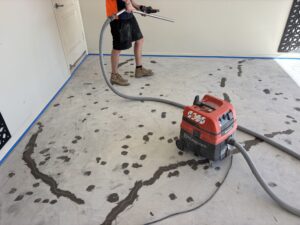
Using commercial-grade diamond grinding equipment with dust extraction, we grind the slab to a CSP 3–4 mechanical profile. This opens the concrete’s pore structure so the epoxy bonds permanently to the slab — not just sits on top of it. We never acid-etch. Acid etching leaves residue, fails to open the pore structure adequately, and is well-documented to cause premature failure.
Step 3: Crack Repair and Defect Filling
Every crack, hole, and surface defect is filled with a high-performance epoxy repair mortar, levelled flush with the surrounding surface, and allowed to fully cure before any coating is applied.
Step 4: Moisture-Tolerant Primer
A penetrating epoxy primer is applied to seal the slab, prevent outgassing (the cause of surface bubbles in Queensland’s warm conditions), and create the chemical bond for subsequent layers.
Step 5: Epoxy Build Coat and Aggregate Broadcast
The main epoxy body coat is applied to specification. Anti-slip aggregate (quartz or aluminium oxide) is broadcast into the wet coat so it’s locked into the surface — not just sitting on top. Coved skirting is formed and applied at this stage.
Step 6: Anti-Microbial Topcoat, Cure and Handover
A chemical-resistant, food-grade topcoat is applied as the final layer. We conduct a full inspection before handing over, provide written care and maintenance instructions, and issue your workmanship warranty documentation.
All Supreme Coatings AU commercial installations are covered by a workmanship warranty, and the industrial-grade products we use carry a separate manufacturer’s product warranty. Your floor investment is protected from day one.
Who We Serve Across Wide Bay
Supreme Coatings AU installs commercial kitchen epoxy flooring for businesses throughout the Wide Bay and Burnett region, including:
- Restaurants, cafés and takeaway shops — Hervey Bay, Maryborough, Bundaberg, Gympie, Howard, Childers
- Pubs, clubs and function venues — across the Fraser Coast and Bundaberg regions
- Aged care and hospital kitchens — HACCP-compliant systems with AS 4586-rated anti-slip
- Food manufacturing and processing facilities — Bundaberg and surrounds; heavy-duty mortar epoxy systems
- School canteens and institutional kitchens
- Caravan parks, resorts and tourist accommodation — Hervey Bay, Rainbow Beach, Tin Can Bay
If your business operates a commercial kitchen anywhere in Wide Bay, we cover your area. Call (07) 4124 6084 to discuss your project.
People Also Ask — Commercial Kitchen Epoxy Flooring
Is epoxy flooring suitable for commercial kitchens?
Yes. Seamless epoxy flooring is one of a small number of flooring systems that meets all requirements of the Australia New Zealand Food Standards Code Standard 3.2.3 for commercial kitchen floors. Its non-porous, seamless surface resists bacterial growth, withstands commercial cleaning chemicals, and can be installed with anti-slip aggregates rated to AS 4586 for staff safety. It is widely specified by environmental health professionals and HACCP auditors for food service environments.
What flooring is required for commercial kitchens in Queensland?
Under the Australia New Zealand Food Standards Code (Standard 3.2.3), commercial kitchen floors must be smooth, impervious to liquids, free from cracks and crevices, and easy to clean and sanitise. They must not harbour pests or allow water to pond. Seamless epoxy flooring meets all these requirements. Ceramic tile fails due to grout lines, bare concrete fails due to porosity, and most vinyl systems fail due to seam deterioration under commercial cleaning regimes.
How long does commercial kitchen epoxy flooring last?
A professionally installed commercial kitchen epoxy system — with correct surface preparation (diamond grinding, not acid etching), a correctly specified build coat thickness (typically 2–5mm), and a chemical-resistant topcoat — typically lasts 15–20 years in commercial kitchen conditions. The key determinants of longevity are the quality of surface preparation, product specification, and routine maintenance. Inferior preparation or budget products will significantly shorten the lifespan.
How soon can a commercial kitchen reopen after epoxy installation?
With a standard epoxy system, light foot traffic is possible within 24 hours of topcoat application, and full commercial resumption (equipment reinstated, full cleaning regimes) is typically possible after 72 hours. For businesses that cannot tolerate downtime, fast-cure polyaspartic systems allow walk-on within hours and full operational use within 24 hours. Supreme Coatings AU schedules installations outside trading hours where required.
Can epoxy be installed over existing tiles in a commercial kitchen?
In some cases, yes — provided the tiles are fully bonded to the slab, there are no hollow sections, and the surface is correctly prepared. However, in most commercial kitchen environments, we recommend tile removal before epoxy installation. Hollow or poorly bonded tiles will cause the epoxy to delaminate from below, regardless of surface preparation quality. Every project is assessed individually at the free on-site quote stage.
Is epoxy flooring slippery in a commercial kitchen?
Not when correctly specified. Our commercial kitchen systems include anti-slip aggregates broadcast into the topcoat — quartz or aluminium oxide granules that provide grip even on wet, greasy surfaces. We can specify systems rated to P4 or P5 under AS 4586 (the wet pendulum test), which is the appropriate slip resistance standard for commercial kitchen wet areas. A smooth, unmodified epoxy without anti-slip aggregate would be slippery when wet — which is why we include anti-slip as standard on every kitchen installation.
How much does commercial kitchen epoxy flooring cost in Wide Bay?
Commercial kitchen epoxy flooring is priced per square metre and varies based on the size of the kitchen, the condition of the existing floor (whether crack repairs or tile removal are needed), the epoxy system specified (a 2mm self-levelling system costs less than a 5mm mortar epoxy), and whether coved skirting is included. Because no two kitchens are the same, we don’t publish online rates — a free on-site assessment is the only reliable way to provide an accurate quote. Contact Supreme Coatings AU at (07) 4124 6084 to arrange yours.
Does commercial kitchen epoxy flooring meet HACCP requirements?
Yes. A seamless, non-porous epoxy floor directly addresses several HACCP prerequisite program requirements, particularly those related to facility sanitation, pest control, and the prevention of cross-contamination through flooring surfaces. The seamless surface with coved skirting eliminates harbouring points for bacteria and pests; the chemical resistance allows the use of approved sanitisers without surface degradation; and the impervious surface prevents moisture ingress that would otherwise compromise food safety.
What’s the difference between epoxy, polyaspartic, and polyurethane flooring?
Each system has its strengths and the right choice depends on your environment. Epoxy builds excellent thickness and chemical resistance — ideal for heavy commercial kitchens and food processing areas where a robust, thick-build system matters most. Polyaspartic coatings cure much faster (often within hours), handle a wider range of application temperatures, and offer outstanding UV stability — well suited to workshops, warehouses, and spaces that need a fast turnaround. Polyurethane coatings excel in flexibility and abrasion resistance, making them a strong choice for workshops and industrial floors that take heavy impact and foot traffic. In many cases we combine systems — an epoxy base with a polyaspartic or polyurethane topcoat — to get the best of both. Supreme Coatings AU will recommend the right system for your specific environment at the assessment stage.
About Supreme Coatings AU
Supreme Coatings AU is a locally owned and operated epoxy flooring company serving the Wide Bay and Burnett region from our base here in Queensland. We install commercial, industrial, and residential epoxy flooring systems across Hervey Bay, Maryborough, Bundaberg, Gympie, and all surrounding communities.
Every project we take on is backed by:
- QBCC-licensed installation — required by law for commercial flooring work in Queensland
- Industrial-grade product systems — no hardware store products, ever
- Diamond grinding on every project — the only preparation method that guarantees a permanent bond
- Workmanship and product warranty — your investment is protected in writing
- Free on-site assessments — no obligation, no online guesswork pricing
We understand Wide Bay’s climate, its local industries, and the real-world demands placed on commercial kitchen floors in this region. That knowledge is built into every specification we recommend.
Get Your Free Commercial Kitchen Floor Assessment
Your kitchen floor is a compliance asset, a safety system, and a long-term business investment. If it’s cracked, porous, grout-lined, or failing under your current cleaning regime — it’s working against you.
Supreme Coatings AU offers free on-site assessments for commercial kitchen flooring projects across Wide Bay.
We’ll inspect your existing floor, conduct a moisture test, identify any compliance or safety risks, and provide a detailed written quote for a system that meets Queensland Food Safety requirements and the specific demands of your kitchen environment.
Call (07) 4124 6084 — or request your free quote online.
Serving Hervey Bay · Bundaberg · Maryborough · Gympie · Fraser Coast · Burnett Region